It's a question heard often from newer researches trying to learn about and get acquainted with period sources. Someone will suggest looking at a publication and the newer person wonders over the prospect of trying to find a 160 year old magazine. Researchers love Goolge Books and the like for the access they offer, librarians like them because we love showing people easy ways to find what they want. In the past decade a number of organizations have digitized a multitude of 19th century magazines, in some cases complete runs of really wonderful and significant titles. Most allow users to search the text, some allow users to page through as if they have the original paper in front of them. Unfortunately there is no one source to look at to see what is in these many digitization projects collectively, there isn't even a truly comprehensive source of all of the many digitization projects detailing their areas of focus. And in some cases the text is not searchable by Google or other search engines.
Am I cruel? I've just told you there are gold mines out there, pointed out that they are hidden, and didn't tell you where to look!
I have attempted to make this easier for people. I have something of an obsession with 19th century ladies' magazines and I have already done much hunting, pecking, and sorting. I have put my rather extensive list of bookmarks into a publically accessible list. This list is by no means complete, in fact I still have at least one more file I need to merge into this list. And of course there are more and more showing up all the time. I will update this as I remember to, this is much (MUCH) easier to update than building a webpage so updating is more likely to happen. Because my bookmarks started with fashion research there is some bias in the types of magazines I collected links to, if you want the Ladies Home Journals and Cosmos of the day they are there, if you want agriculture they aren't.
The list is in a Zotero group. Zotero is citation and research tracking software (and it's free!). Zotero tries to encourage collaboration and in that spirit they try to make it easy for researchers to share, the groups are part of that effort. The information offered right up front is minimal but you can add more (publication dates and such) with the icon to the far right over the list. When you open the group it will be sorted in alphabetical order but if you're looking for specific years more than titles you can resort it by date. If you sign up for an account with Zotero you can make your sorting and display "stick" from visit to visit. You can save these links to your regular bookmarks or set up a Zotero account and save them there where you can also annotate them (make notes, tag them, etc.)
Before you are totally bored and stop reading (those who didn't already) the list can be found at 19th Century Fashion Magazines.
Tuesday, June 25, 2013

Sunday, February 10, 2013
Border for the Above
Or
Part two of "Laurel Leaves of the Wooly Sort"
In "Laurel Leaves of the Wooly Sort" I looked at translating finicky, or should I say mucked up, stitch patterns. Immediately after "Laural Leaf" Elizabeth Jackson offered up a border, as with Laurel Leaf the border pattern needs some creative fixing.
The pattern from The Practical Companion to the Work Table :


The most obvious problems...
"Take up stitches", how many, how? How many is a complicated question. Pick your preferred method for picking up, I'll look at how many later.
Row 5, where is row 5? See the last bit on row 4, that is row 5.
"cast one on" in the middle of a row? Use a yarn over
"and so on", for how long? As long as you like, but see my warning later.
Why are her patterns so wacky? There are three types of knitting books in the 19th century: a small handful with original content, a great many of reprints of those retitled and with different publishers, and a handful of mashups. Elizabeth Jackson "wrote" a mashup, she took patterns from other sources and compiled them into one book. Unlike most who stole content from others she rewrote them. I haven't taken the time to do a pattern by pattern analysis of the book but I know some of the patterns came from earlier works of Jane Gaugain. In rewriting the patterns she was inconsistent in her notation. While you certainly could do a cast on mid-row it's unusual unless you are doing many. She used at least three different terms in places I would expect a plain old yarn over. She also either mucked up the math as she rewrote or she was just plain bad in math.
Making this pattern do something, preferably something pretty...
The first three rows are just foundation or setup rows the pattern itself is rows 4 - 7 which keep repeating. 4 (and again as 8) is the only real pattern row, that makes this an easy pattern to work, well, once you make it work. Sometimes her use of semi colons offer clues about what she means and which stitches should be grouped together, consistency is a problem though. She muddles this but not too badly, just oddly. If you look closely she repeats the pattern but in an odd way, not writing the instructions the same for both repeats and splitting it. She does "narrow three times" four times, so if this is two repeats we need two of them and one each of the other two sets of stitches, the middle of her line (highlighted in green) turns out to be one repeat. What gets repeated five more times? Everything from the preceding ";", so yarn over knit one. Am I sure? Well, if we're going to keep repeating the same pattern row we need to keep the same number of stitches in every row. If we "narrow three times" twice we've decreased 6 stitches so we also need to increase 6 stitches. Buried in her wonky writing is a very common variation of "Feather and Fan" which has a plain stitch in the center of the decrease section. I may have caught what was going on here more quickly than some would. Feather and Fan was the first lace pattern I learned cough cough years ago. I can probably do it in my sleep, actually, I was accused of that once...
slip one, knit one, narrow three times; knit one, narrow three times; cast on one, knit one, repeat five more times; narrow three times; knit one, narrow three times; cast on one and knit one six times; repeat to the end of the row;
Rewritten:
S1 *k1, k2tog 3x's, (yo k1)6x's, k2tog 3x's* repeat to end of row
I would add one stitch at the end for better balance and a cleaner edge


For each repeat you need 19 stitches, then one or two for the S1 and k at the ends.
If you knit it in this order, instead of stacking the decreases to the one end as she wrote it, you'll have the same portion of the pattern at each corner of the shawl.
This pattern is pretty and easy to work for cuffs, scarves and even little knit miser's purses.

Take up stitches and row 2...
I'm really not sure what she was thinking. No matter how you read row 2 it will increase the number of stitches rather dramatically. Did she think knitters couldn't pick up enough stitches along the edge? Did she think the greater fulness gave some flexibility to let you pull out the scallops more to accentuate them? If her intention really was to increase from what was picked up to a number for the actual pattern she failed, epically. The increases in row 2 can be worked to match the stitches needed for row 4 for just one repeat then it doesn't work till you hit 5 repeats from there I don't know the next match, I stopped my "algebra exercises for knitters" at 10 repeats. If this is what you think you want to do you can engineer it to work with a little math.
Slip the first stitch, cast one on, knit one, cast one on, knit two, repeat within one stitch of the end; cast one on, knit one.
The repeating part is the "cast one on, knit two" and it has a cast one on at each end, and the slip one. So some number of yo, k2 with three extra stitches and every two stitches becomes three. But you need to do the math to make it work with the pattern repeat of 19 with 2 more.
If you picked up 100 on each side you have 200
200 after the row 2 increases would be 299 (it's not exactly 1.5 times because of those end stitches)
19 goes into 299 15.736 times.
huh...
You would have 15 repeats of the 19 stitch pattern and 14 extra stitches so you need to either skip 14 increases or add 5 more. I always opt for the closer number so I would add 5. You can evenly space them or, in this case, I would concentrate them in one spot. This pattern has you trying to fit a straight strip onto a triangle. That won't work. If you want it to sit nice and flat at the point you need to add more stitches around the corner to almost gather the border there. Then knit till it's as deep as you like, cast off loosely and you're done!
But...
This border on this shawl kind of puzzles me. You usually see more narrow edgings knit in a long strip and seamed on on half, or triangle, shalws. Those narrow strips are easy to manipulate around the corners. Feather and Fan variations show up frequently on Shetland-esque shawls as deep borders. The pattern really needs to be knit to a nice depth to visually develop and to make those edges to undulate deeply. The patterns for those shawls include increases at the corners to accommodate the shaping, avoiding the problem I mentioned above. Did Mrs. Jackson take the border from one shawl and try to put it onto another? And in her rewriting lost the shaping? Sometimes the Shetland type shawls had a row of yo k2tog between the main pattern and the borders just to help break the two patterns visually. Let's look again at the wonky row 2.
Slip the first stitch, cast one on, knit one, cast one on, knit two, repeat within one stitch of the end; cast one on, knit one.
If you change the "cast one on, knit two" to "cast one on, knit two together" your stitch count remains stable except at the ends.
If you kept doing the start and end "cast one on, knit one" you would be increasing the two ends. If you worked the two sides as two separate and complete sections you would have
increase - pattern - increase - increase - pattern - increase
The increases at the far ends would keep the border running in line with the top edge of the shawl while the double increase in the middle would nicely miter the corner.
I'm pretty sure this is what she intended. I don't know why she rewrote the patterns she stole, others didn't seem to feel a need to. The rewriting seemed to constantly trip her up.
How I would work it:
Pick up stitches along the two outer edges, mark the center. This is all written for one side then repeat it on the second side.
Check the stitch count, if it's not divisible by 19 with 3 extra slip in some extra or decrease a few to make up the difference. It's often easiest to do that on the first row. If you picked up 100 stitches on each side you have 97 to work in the pattern. 5 repeats of the 19 stitches is 95. Just lose two that you picked up.
When you pearl the first row be sure that you are looking at the wrong side of the shawl
1. Pearl
2. S1, {yo, k1 *yo, k2tog* repeat to one stitch from the end, yo, k1}, repeat everything in curly bracket on the second side
3. Pearl
4. S1, {yo, k1, *k2tog 3x’s; (yo, k1) 6x’s, k2tog 3x’s k1* yo, k1} repeat everything in curly brackets on the second side
5. Pearl
6. S1 {yo, K to one stitch from the end, yo k1}, repeat everything in curly brackets on the second side
7.Pearl
8. same as 4
Repeat 4 - 7 to desired depth, cast off losely.
I don't have a swatch showing the miter, I'll try to get one done and posted.
Friday, April 27, 2012
Should I wear...?
An introduction to evidence based research for historic costuming
Newcomers to
costumed historical interpretation or reenacting often spend much time asking
“do I need to wear …?” The natural instinct is to just ask those closest, or
those you have bumped into on the internet. Sometimes that’s great, sometimes
not so much. Either way, at some point you need to start doing your own
research and setting your own standards based on that. Unfortunately the type
of research you need to do is far from
what we were taught in high school or college. That knowledge might help you
find a picture but you need to know how to “read” the picture. You need to
glean the details from it not just paste it into a report. The good news is
that in the past fifteen years an astonishing amount of primary sources for the
19th century have found their way onto the internet.
How do
you use those primary sources to decide if you need to wear x, y, or z? Let’s
start with gloves. Partly because I’m in the midst of some research on them and
they are on my mind, partly because I hear that question a lot. And, I too
often hear a myth that women always wore gloves when they went outside.
So…do I need
to wear gloves when I go outdoors?
It fairly
safe to start of with some assumptions to start (be prepared to be wrong once
and a while though). We’ll start with the assumption that some women wore
gloves some of the time. It can help you frame the real questions – who, when,
where, and what did they look like.
Let’s look at
a few pictures, if you want to know what people really did pictures are
wonderful. Magazines will tell you what they aspired to do, just like Cosmo and
Martha Stewart tell us what we are supposed to aspire to. I’m pretty sure they
attained those aspirations at the same low rate we do.
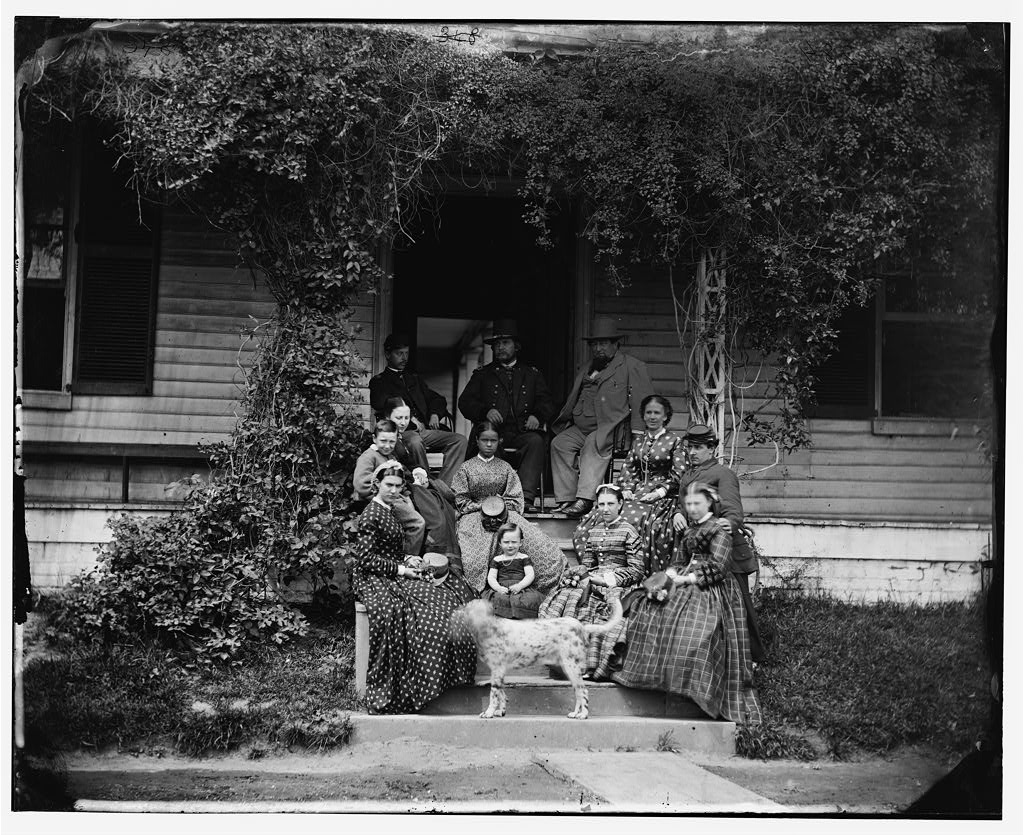
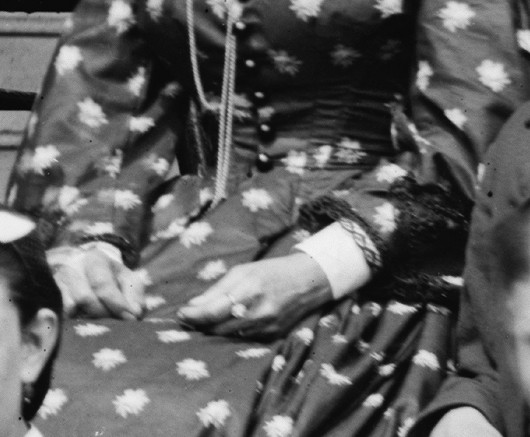
Gloves can be
hard to spot so blow up the picture…detail of some hands.
And another
of some officers and ladies at Fort Monroe

And another closeup.

It’s actually
difficult to find photographs, set outside, with women wearing gloves which are
clear enough to see any detail. Lucky for us many women donned their outerwear
for studio shots, like the lovely Miss Chapman.

Again, zoom
in to see what is really going on. Are they bulky or sleek? Loose or tight? If
we can see the outline of her nail and the creases over her knuckles they must
be both tight and thin. One picture is not enough to base things off though so
keep looking, also pay attention to the length. How far over the wrist are
they? Are there any decorations? If they have gloves but aren’t wearing them
what are they doing with them?

There is much
that photographs can’t tell us about the gloves. Color for one. Museum
collections come in handy to answer that, and more.

Zoom in to get a good look, what do you notice? The seams
are on the outside, not inside like most modern gloves. The leather is very
fine and light/thin. There is no lining. There is a slit on the inside of the
wrist, you need that to be able to get such tight gloves on. The little buckle
and ribbon (or elastic) would close it up to keep it snug at the wrist.
Were they all black or white? Don’t let gray scale photographs fool you,
they loved color. A lovely lavender pair from the MET, http://www.metmuseum.org/Collections/search-the-collections/80032192?rpp=20&pg=3&ao=on&ft=gloves&when=A.D.+1800-1900&pos=46#fullscreen

Look closely and you’ll see they are quite similar. The cuff
has some pretty decoration and the buckle has been replaced by buttons but
aside from that there isn’t much different.
Genre paintings and fashion illustrations will also help us confirm that women did indeed wear gloves outdoors.

The "Cordovan" from Godey's August 1861

Genre paintings and fashion illustrations will also help us confirm that women did indeed wear gloves outdoors.
Henry Alexander Bowler’s “The Doubt: ‘Can these Dry BonesLive”, 1855

The "Cordovan" from Godey's August 1861
Lady’s magazines can help fill in the holes regarding
styles, colors, types available, seasonality, etc. What did Godey’s have to say
about gloves in 1861?
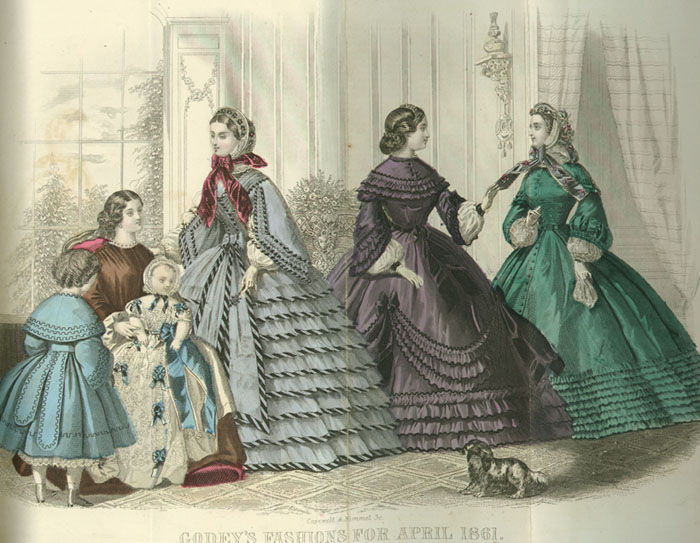
In April:
“Straw-colored gloves, with two buttons, and worked with lavender
color”
“Gloves worked with wine-color to match the dress.”
“Gloves worked with green.”
Looking at the fashion plate and
wondering where the gloves are? Zoom in and you can just barely see three lines
on the backs of their hands, the hands also look a bit flat in color compared
to their faces. The lighter colors – straw, lemon, buff – can be hard to spot
in both fashion plates and photographs. Look for traces of their detail and odd
lines at the wrist.
Newspapers
can help you determine what was available and when. The two following ads ran
in the Brooklyn Daily Eagle throughout 1861. The kid gloves were
advertised all year, the silk taffeta on the other hand only shows up June
through September.


Don’t rule
out fiction of the day as a source. It can be especially helpful for shedding
light on the who and when. Watch for clues about context – are they in the city
or the country, is the character wealthy or poor, are they lauding the person
or poking fun at her, and such. Returning to Godey’s from 1861:
From “Sunshine
and shade; or, the governess”: “…on the morning before Christmas we find her
and her two pupils dressed for a short journey; they are going to Augusta to
spend the holidays, and as they stand before the sitting-room grate, drawing on
their gloves, Martha and Mary bewail the inopportune illness of the overseer…”
What clues
are here? Late December can be cold, even in the South where this takes place.
Even in just cool weather sitting in an unheated carriage for hours might
prompt the hardiest of women to want gloves. The young ladies are of a class to
have a governess so they are likely better off. A few sentences later it's confirmed that they are on a
plantation.
From “A new
version of Paul and Virginia”: “…They admired the folding of her veil over the
bonnet, the neatness of her gloves, even the manner in which her shawl was
pinned; one judges character by trifles. She had with her a crimson-lined traveling
bag, not crowded but full of dainty luxuries…” when Virginia reached her
destination: “Miss Rachel, divested of garden gloves and dress, in a clean chintz
wrapper, superintended Virginia’s unpacking”
Again, gloves
for travel and someone rather better off. But, also there were specific gloves
for gardening.
From “Mr and
Mrs Rasher”: “…Well! You’re able to stand a little imposition, and you don’t
suppose I’m going to let ’em see I ever stepped into a kitchen. My hands show
it! No, they don’t; and I’m going to keep ‘em done up nights in old gloves, and
oil ‘em every night with – lard oil? – stuff! with rose cream”
When you
wear out you gloves they still have a purpose! Take a closer look at the story though. The Rashers seem to have started in lower place and made enough money to move up in society but they are still in transition. That likely explains the switch from lard oil to rose cream.
Of course you
want to look at more sources than what I have here but, hopefully, this gives
an idea of what to look for and how to look at it. So, back to the original question…Should
I wear gloves?
Did women
wear gloves? Yes
Did women
always wear gloves outdoors? No
How to choose
then?
Given your time, place, activities, and socioeconomic
status what types of gloves would you have owned and would they have been worn
daily, saved for good, or just for specific work?
Do you have,
or can you get, gloves which look like, and fit like, their gloves?
Exactly
where you draw the line depends upon your own standards as well as the wishes
of the group you're associated with or museum you’re working for. Never be afraid to bring new information to the table if you think a group might have missed something, that's the only way we'll move forward instead of backward. My own
standard? If it’s an accessory it's not necessary, you can go out without gloves –
they did. If the only gloves you have are bulky, loose fitting modern ones and
it’s 80 degrees out leave the gloves home, they will detract from the better
items you’re wearing and you’ll be more comfortable without them. If the mercury
dips to single digits that’s another matter. Frostbite might be historically
accurate but it’s really not an appropriate sacrifice! Unless you can find someone making good reproduction gloves (and if you do please tell me who!) you need to find where you are happy along that spectrum.
Hopefully
this has helped someone to get started on doing her or his own research!
Subscribe to:
Posts (Atom)