Sunday, August 7, 2011

How not to loose the needle in the haystack.... or.....Keeping track of your library

How often have you stood in a store and wondered "do I already have this book?". Or, had a conversation with someone and wished you could remember the exact title of a book you know they would love to read. Wouldn't be easier if you had a list of all of your books - available on your cell phone (assuming you have a smart phone)?

There are a couple of online services that will let you "build" your own library. Library Thing  is the best known. Library Thing kinda-sorta grew out of public library style reader's advisory services - if Mary Jane reads a lot of the same books as you the two of you might want to share library and reading lists to find titles you might like. It lets you type in just an ISBN and it will find all the usual pertinent data about it. You can tag the books with super short notes and you can build multiple libraries to help sort things. The shortcomings? It's free only up to 200 books (I refuse to count but it's more than that). The display of you library shows only the more basic information (title, author, date), it's meant for pleasure reading where publisher and place really don't matter. You can't make notes longer than a little tag. There is no provision for output into a bibliography. And finally, you can't add links to online versions.

There are a multitude of smart phone apps which purport to track your library for you. I've yet to find anything which comes close to Library Thing yet they all have the same shortcomings. The only thing gained is the ability to scan by barcode instead of typing ISBN's in. (Library Thing will let you scan in if you have a scanner)

So what's an overly nerdy librarian/history geek to do? Oops. I left out cheap, I didn't want to spend  money on this.

Zotero to the rescue. Zotero is citation software created by the Center for History and New Media at George Mason, it's been funded by the IMLS and the Andrew W. Mellon Foundation. It's meant for tracking citations for research but there is no reason it can't work on a more grand scale to track a library. A word of warning, before I get anyone to excited, if  you don't have (and won't use) Firefox you can't use Zotero in the way I'm going to describe. They are working on a standalone version which wouldn't be browser dependent but it's only in alpha, don't hold your breath. The only drawback I have found to this is that there is no "official"  mobile access, you can just look at the website. But, the website is view only so you can't add titles, edit, or add tags. Of course the more  people who ask for a more functional mobile version the better the chances of bumping the project to the top of the list. Zotero will let you enter all of the usual bibliographic data, plus URLs, and has several fields which could easily be re-appropriated. For example, "Location in Archive" could easily be things like "kitchen", sewing rooms" etc for those of us who have books scatter hither, tither and yon. If you were moving and happen to be slightly psycho extra geeky you could use one of those fields for box numbers. You can add tags which you can search against but you can also add longer notes. You can export all or part of the library in several bibliographic formats. If you have an extensive library that could be a really good thing to save -outside your house- for insurance purposes. And since Zotero lets you make as many libraries are you wish you can copy entries into research specific lists. If you have ISBN's Zotero can search those in several databases sparing you manually entering all the data.

Still, the idea of typing all of those ISBN's, in addition to manually entering the oddities I have, seemed daunting. I don't type ISBN's at work I scan them, why would I go backwards at home. But...I really didn't want to buy a scanner. And, I have a phone which scans perfectly well. So I went in search of an app that would let me scan from my phone to my computer. Presto - Bluetooth Barcode Scanner, it's not free but $1.49 seemed cheap enough to try. And since it's Bluetooth I don't even need to have the phone tethered to the laptop. You do need to download some software onto your computer for this to work. If you've got something other than an Android you're on your own but I'm sure there is something similar out there. It's not quite perfect, for want of one little key stroke I need to have the laptop in reach.

So, enough yammering on, here's the nuts and bolts.
Download Firefox if you don't already us it. (it's more secure and more standards complaint than IE)
Download the Zotero app
Download the Bluetooth Barcode Scanner onto both your phone and computer
Open Zotero and make a new folder, name it whatever you would like. I wasn't very creative the night I did mine, it's got the very boring name "library"

Click on the little  wand (add item by identifier)

Open the barcode scanner on both your computer and phone, hit "connect" on the phone and make sure they show that they are connected. Click on "continuous scan"
Scan you first barcode

Check that is found the right book
 (and please ignore the fact the I look like some sort of over the top Facebook addict, I'm not sure why I have ever multiplying FB tabs)

Add tags and notes

Click on the wand again (my one little annoying keystrok)
Keep going.

 Why add tags? Because you can search to see what you own on a topic. It's actually a key word search. So, I have books tagged as lace making and books tagged as lace knitting. If I type in lace I get all, if I type in lace knitting I get just those. (and before anyone starts telling me about lace knitting books I need to buy...I've only just started scanning, there are more, many more)

Why make notes if you can tag? Notes are searchable too but let you say more. So, that favorite receipt that you can never remember what book it's in, leave the name in a note. Note the name you remember it by and the real name so you can find it in the library then find it in the book.There is (as far as I know) an unlimited number of notes. You could also make notes for individual receipts detailing how you've made them.


Zotero will sync to their cloud which is how you can see  your library online. If you work off of more than one computer it will sync all back and forth. You can lock down your library online so only you can see it or you can set up groups so multiple people can see it. I can see this as being a cheap solution for small organizations needing to keep track of books and documents.

Saturday, July 9, 2011

Mitts, Cuffs and Muffatees, Oh My!

Or
Everything Old is New Again

The past few years there has been a slow but growing trend for various forms of knit handwear, from short little mitts to long gauntlet like mitts, some with partial fingers, some a thumb hole and other just a long shoved down cuff. They are nothing new, I have been quite amused at the several "new and novel" items which have wound their way into "modern" knitting in the past few years. Various knit hand warming devices have been around for a long, long time. Their existence long predates my era of study. The first print instructions I know of appear in the 1838 Workwoman's Guide, http://books.google.com/books?id=8OcDAAAAQAAJ. WWG offered patterns for muffatees, mittens, andt mitts, in all 10 patterns, out numbered only by foot coverings. It tells you something about the life of our ancestors before central heat, staying warm was a struggle. WWG offered plain and utilitarian styles, but that was the gist of the whole book. Like all clothing items (at least it seems all) they transcended simple form and joined the ranks of fashion items. Many of the knitting books published in the next few decades offered more fanciful versions - fancy stitches, lacework, multicolored, anything to make the common item pretty. They persist in some form from one end of the Victorian era to the other. Which was favored - mitt versus cuff and so on - varied from era to era but they all had two things in common. They were knit on small needles (00-2) and they were knit on fine yarn (almost always) modern fingering weight . This is where they diverge from the modern versions. Modern knitters make them from heavy and chunky wools assuming that will keep them warm. But then modern people wear them to wander a chilly street while shopping not to try to run a household. The finer historic version lets the wearer layer, a muffatee could be slipped on over a thin glove to extra warmth without hampering hand use as a heavy item would and they can be worn for housework without destroying dexterity. Most stitches used provide some stretch and flexibility allowing for a snug fit, a loose and floppy will make them cumbersome to wear if you try to do any real work. 

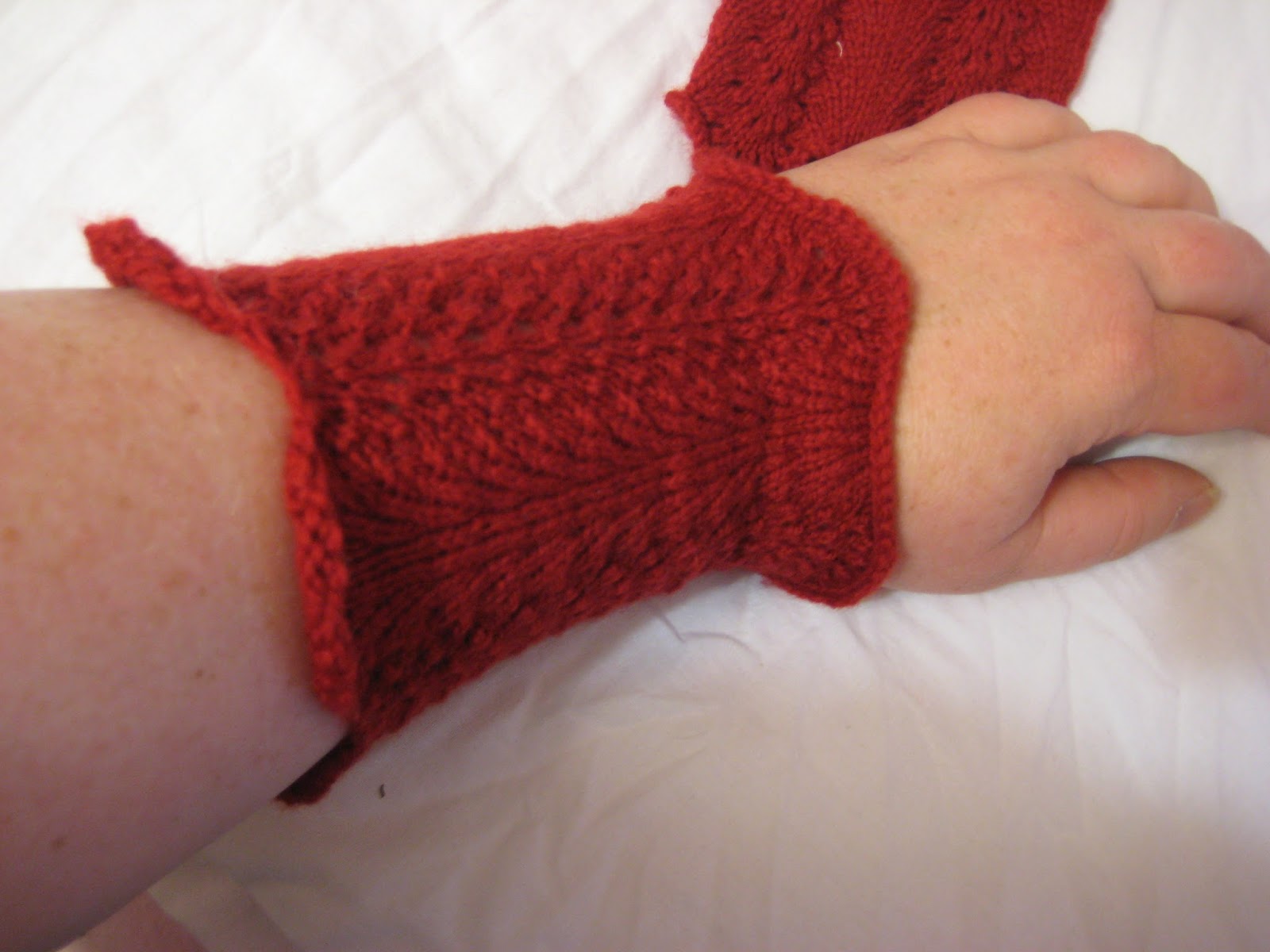
They are small and knit up quickly, a great way to use up scraps of yarn, and a nice project which can let a newer knitter produce a finished project (relatively) quickly.  As a very visible costume item they also get noticed and are good conversation starter leading to conversations about not just knitting but the difficulties in keeping a house warm and trying to keep oneself warn while working outdoors. One word of caution if you want to knit some - many of the patterns end up rather small so swatch the pattern stitch and adjust the stitch count accordingly. You can try going up or down one needle size but unless your knitting is extremely tight or loose changing needle size more than that will alter the texture of the knitting too  much. Below are some pictured of some styles ranging through the Victorian era. All were knit for a knitting workshop I recently taught at the national ALHFAM conference.

 Knit Muffatee, Workwoman's Guide, 1838


Corkscrew Muffatee, Exercises in knitting, 1846 


Feather Mits, The ladies’ self instructor in millinery and mantua making, 1853


Winter Cuffs in Double Knitting, Godey’s Lady’s Book and Magazine, February 1861


Lady's  Mitten with Thumb, Weldon’s Practical Knitter, First Series. 188x


Knitted Cuffs, The art of knitting, 1991


Wednesday, August 18, 2010

Laurel Leaves of the wooly sort

A note...

There seems to be some growing confusion in some groups about who wrote this pattern. So, to clarify – this pattern, and the entirety of this blog, was written by Beth Chamberlain, you can see my bio on the side.

This pattern is my own interpretation of an 1840s pattern, which did not work as published. I first used this as an exercise for a workshop on working with Victorian era knitting patterns. When I shared it here I never imagine how much interest there could be and that I would start something of a fad in some reenacting circles. I appreciate the interest, I appreciate the sharing of links to the blog, I would also appreciate being credited for my work.

As long as I am adding this note I would also like to draw attention to the note which was already at the bottom Pattern published for personal, non-commercial use only.” It’s a fairly standard concept in pattern publishing and use, you can use the pattern as many times as you want for yourself but as a soon as you start selling items from it it’s commercial production, I am not granting that right. If you’re thinking I won’t hire a lawyer to enforce it you’re right that I would have a hard time justifying that cost. If that thought came to mind, for this or any other published pattern, I urge you to reexamine your personal ethics. If someone would like to license the pattern to use it for commercial production contact me and I will consider it.


Knitting instructions are finicky creations. Proof reading them is like trying to make sense of a random string of letters and numbers.  Today it's not uncommon to find erratas for the patterns published in both books and magazines. In the 19th century they skipped the erratas and left it to the knitter to figure out what the problem was. Combine the barely existing standardization, each author using her own shorthand, and the seeming complete lack of proof reading and 19th century instructions can be more a puzzle than anything else. I like puzzles so every now and then I set down and try to figure out one of the mystery patterns. Sometimes it's just because I'm curious, sometimes because someone else has run into a problem. Instead of cramming my notes into my bookshelf where they help no one besides myself I'm going to try posting them in hopes of saving someone else from counting stitches and scratching her head. 

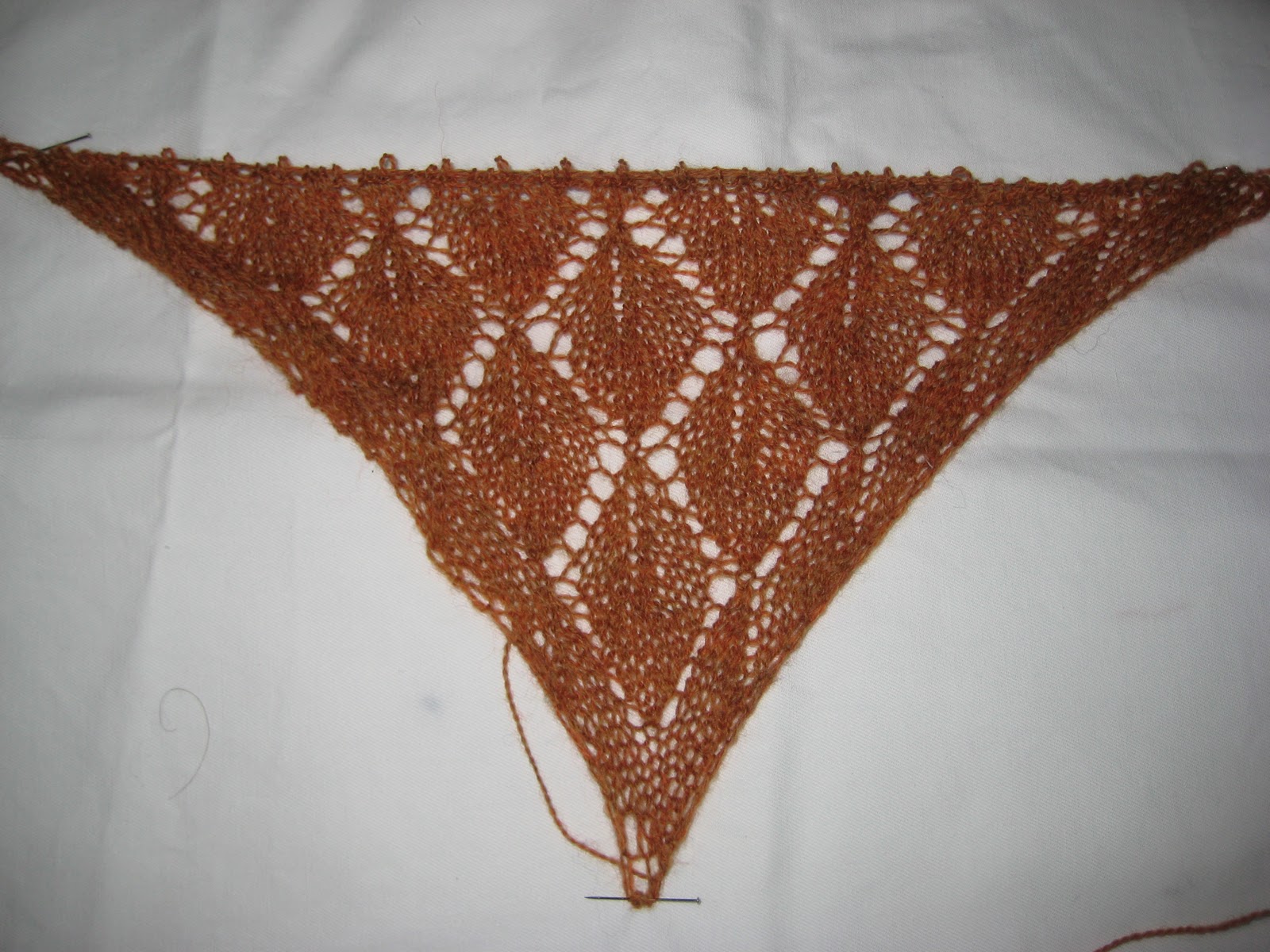
The first installment is the Laurel Leaf from Elizabeth Jackson's The practical companion to the work table, containing selections for knitting, netting and crochet work, published in 1845. In this case the Laurel Leaf was intended for a half square shawl but other versions of it show up routinely in 19th century (as well as 20th) for various other items. It's a nice simple, slightly open pattern, perfect for a newer knitter or for working in slightly dim light. Elizabeth Jackson was nice enough to provide an illustration of the beginning of a shawl. Sometimes illustrations bear no resemblance to the  pattern, sometimes the pattern bears no resemblance to the illustration. The later is the case here. The image looks like a leaf, her instructions don't.
In fact, her instructions just don't work. Her original instructions can be found at the link above, in the interest of saving space I won't repeat what doesn't work. The problems start with the very first row, the pattern requires an odd number of stitches, she started off right but then blew it in the increases on the first row. The shawl starts at the bottom corner with just three stitches. Increases are worked along each edge at every pattern row and rows 6 and 16 have a spare set of increases (one at each end) to accommodate the pattern. My interpretation:
Work a Purl row after each pattern row

Cast on 3
1.   s1 yo k1 yo k1
2.   s1 yo k3 yo k1
3.   s1 yo k5 yo k1
4.   s1 yo k7 yo k1
5.   s1 yo k9 yo k1
6.   s1 yo k5 yo k1 yo k5 yo k1
7.   s1 yo k1 k2tog k3 yo k3 yo k3 k2tog k1 yo k1
8.   s1 yo k2 k2tog k2 yo k5 yo k2 k2tog k2 yo k1
9.   s1 yo k3 k2tog k1 yo k7 yo k1 k2tog k3 yo k1
10. s1 yo k4 k2tog yo k9 yo ok2tog k4 yo k1

11. s1 yo k5 yo k1 yo k4 k2tog k2tog k3 yo k1 yo k5 yo K1

12. s1 yo k1 k2tog k3 yo k3 yo k3 k2tog k2tog k2 yo k3 yo k3 k2tog k1 yo k1
13.  s1 yo k2  k2tog k2 *yo k5 yo k2 k2tog k2tog k1* repeat to 12 from end, finish:yo k5 yo k2 k2tog k2 yo k1
14.  s1 yo k3 k2tog k1 * yo k7 yo k1 k2tog k2tog * repeat to 14 from end, finish: yo k7 yo k1 k2tog k3 yo k1
15.  s1 yo k4 k2tog * yo k9 yo k3tog* repeat to 16 from end, finish: yo k9 yo k2tog k4 yo k1
16.  s1 yo k5 yo k1 *yo k4 k2tog k2tog k3 yo k1* repeat to 6 from end, finish: yo k5 yo k1
17.  sl yo k1 k2tog k3 * yo k3 yo k3 k2tog k2tog k2*  repeat to 10 from end, finish: yo k3 yo k3 k2tog k1 yo k1

Repeat rows 13-17
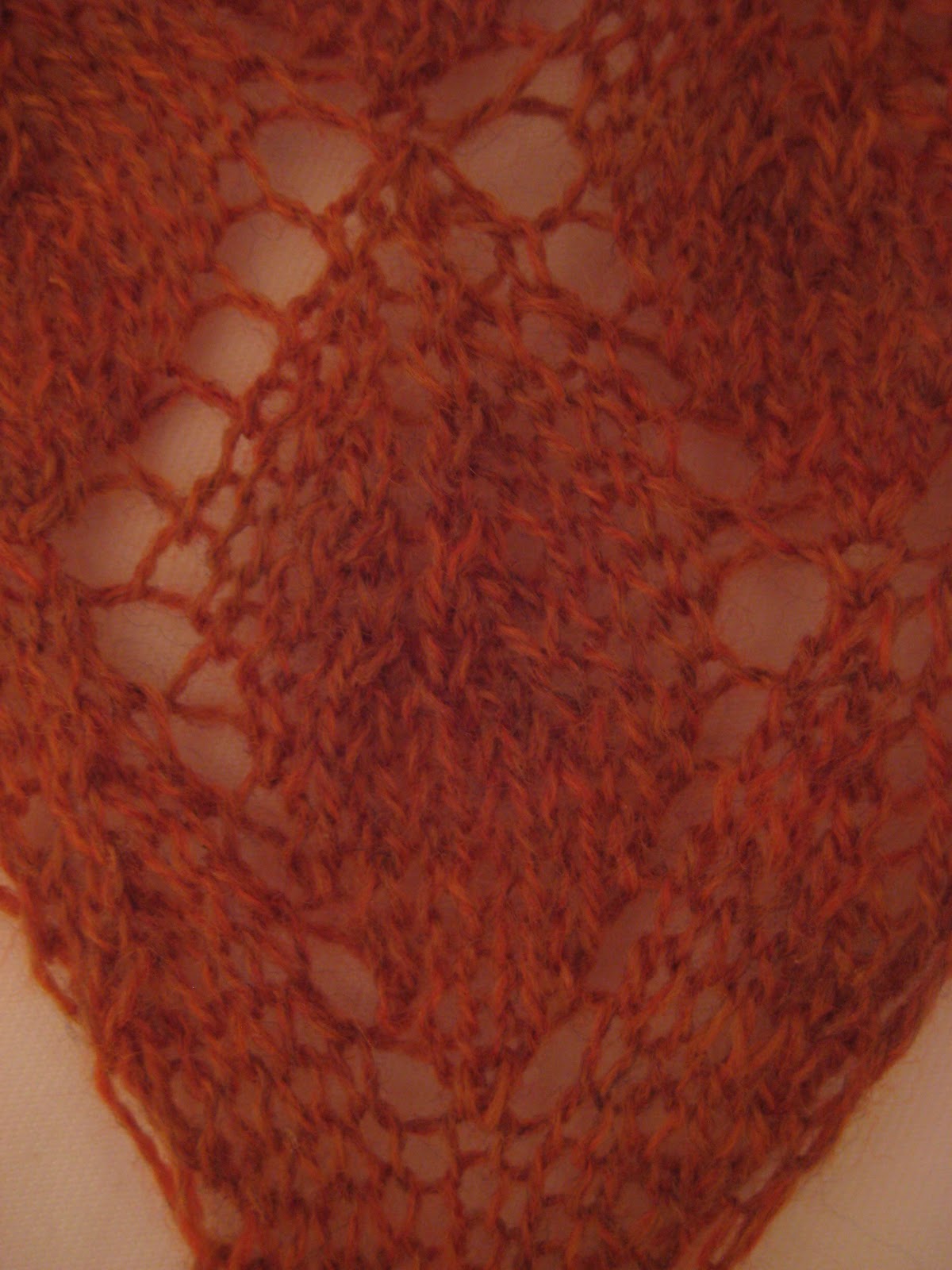
If using this for a shawl I strongly suggest slipping the first purl stitch to give a nicer edge and balance the slipped stitch in the knit rows. Below are images of samples worked by my interpretation. They are worked in a lace weight wool (akin to the Shetland recommended in the pattern) and size 3 (modern) needles.

Pattern published for personal, non-commercial use only.